Postcards |
Intro van Gogh |
His Suicide |
van Gogh postcard
beautiful offset-printed
on 320 grs carton
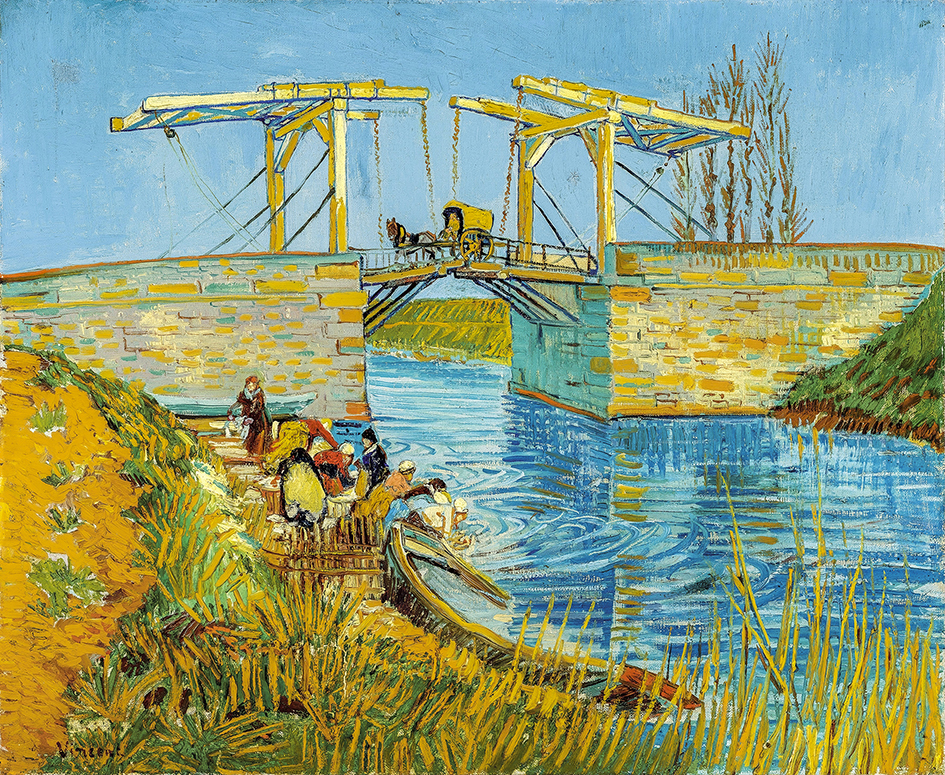
Bridge in Langlois
Vincent van Gogh (1853 - 1890), Arles, 1888, oil on canvas, 50 cm x 65 cm.
The Langlois Bridge was one of the crossings over the Arles to Bouc canal. The double-beam drawbridge was built in the first half of the 19th century to expand the network of canals to the Mediterranean Sea. Locks and bridges were built, too, to manage water and road traffic. Just outside Arles, the first bridge was the officially titled "Pont de Réginel" but better known by the keeper's name as "Pont de Langlois". In 1930, the original drawbridge was replaced by a reinforced concrete structure which, in 1944, was blown up by the retreating Germans who destroyed all the other bridges along the canal except for the one at Fos-sur-Mer, a port on the Mediterranean Sea. The Fos Bridge was dismantled in 1959 with a view to relocating it on the site of the Langlois Bridge but as a result of structural difficulties, it was finally reassembled at Montcalde Lock several kilometers away from the original site. According to letters to his brother Theo, van Gogh began a study of women washing clothes near the Langlois Bridge about mid-March 1888 and was working on another painting of the bridge about 2 April. This was the first of several versions he painted of the Langlois Bridge that crossed the Arles canal. Reflecting on van Gogh's works of the Langlois Bridge Debora Silverman, author of the book Van Gogh and Gauguin: The Search for Sacred Art comments, "Van Gogh's depictions of the bridge have been considered a quaint exercise in nostalgia mingled with Japonist allusions." Van Gogh approached the making of the paintings and drawings about the bridge in a "serious and sustained manner" with attention to "the structure, function, and component parts of this craft mechanism in the landscape." In Arles van Gogh began using again a perspective frame he had built in The Hague. The device was used for outdoor sightings to compare the proportion of items that were near to those that were in the distance. Some of the works of the Langlois Bridge were made with the aid of the frame. Its use "deepened his exploration of the drawbridge as a mechanism." The Langlois Bridge reminded van Gogh of Hiroshige's print Sudden Shower on the Great Bridge. Inspired by the Japanese wood block prints, van Gogh sought to integrate techniques from Japanese artwork into his own. In a letter to Émile Bernard about the Langlois Bridge, he wrote: "If the Japanese are not making any progress in their own country, still it cannot be doubted that their art is being continued in France." With a Japanese aesthetic, van Gogh's Langlois Bridge paintings reflect a simplified use of color to create a harmonious and unified image. Outlines were used to suggest movement. He used fewer shades of colors, preferring multiple subtle color variations. The Langlois Bridge reminded van Gogh of Hiroshige's Sudden Shower on the Great Bridge inspiring him to use blocks of colors, like patterns of yellow against a blue sky, colors chosen to create a sense of vitality of the Japanese prints and the vibrant quality of light in southern France. These approaches created a more powerful impact and depicted the simpler, primitive quality of the country lifestyle.
Email: jancvanroekel@gmail.com