Postcards |
Intro van Gogh |
His Suicide |
van Gogh postcard
beautiful offset-printed
on 320 grs carton
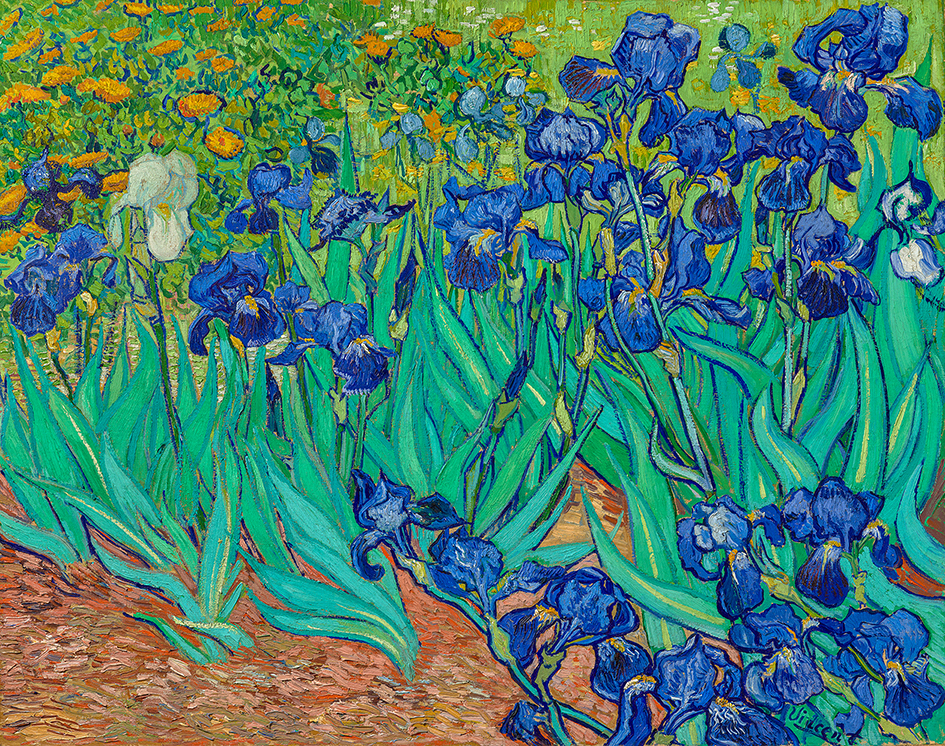
Irises
Vincent van Gogh (1853 - 1890), St Remy, 1889, oil on canvas, 71 cm x 93 cm.
Irises is an oil painting by Dutch artist Vincent van Gogh. Painted in 1889, the work is a landscape with a cropped composition and is one of a series of several hundred paintings that van Gogh made at the Saint Paul-de-Mausole asylum in Saint-Rémy-de-Provence, France, in the last year before his death in 1890. It has been in the permanent collection of The Getty in Los Angeles, California since 1990.
The painting depicts vibrantly blooming irises with dynamic brushstrokes. The flowers are a mix of deep blues and violets, contrasting with lush green leaves, red-orange earth, and yellow flowers in the background. Van Gogh's characteristic impasto technique adds texture and movement within the painting, creating an energetic and expressive feeling. The overall cropped composition of Irises, includes broad areas of vivid color and monumental rippled irises overflowing the borders of the canvas which helps moves the viewer's eye throughout the canvas.
In May 1889, van Gogh voluntarily entered the Saint-Paul-de-Mausole asylum in nearby Saint-Rémy, where he painted around 150 canvases over the course of the next year. In this protected and limiting environment he could florish and further develop his unique painting-style. Here he reached his top. Here he made among his best works: Irisses, Starry Night, Roses, Wheatfied with Cypress....
His initial confinement to the hospital grounds is reflected in his imagery, from depictions of its corridors to the irises and lilacs of its walled garden, visible from the window of the spare room allocated as his studio. Vincent was restricted to the premises, where his only connection with nature was the enclosed garden and the view from his bedroom window. He visited the garden to find solace in painting, an early example of what is now called art therapy. In a letter to his brother Theo, Van Gogh mentioned that he had begun a painting of 'violet irises', a reference to Irises. Van Gogh was optimistic about the restorative effects of painting in the hospital garden, writing: "I believe that all my faculties for work will come back to me quite quickly".
Van Gogh started painting Irises within a month of his one-year stay at Saint-Paul-de-Mausole, in May 1889, working from nature in the hospital garden. Van Gogh himself regarded this painting as a study, and there are no known drawings for it. Irises bears a direct trace of his work there: embedded in the paint is one of the pollen cones that fall in abundance from the umbrella pines in the garden.
During his stay at the Saint-Paul-de-Mausole asylum, van Gogh painted several depictions of irises. Another painting, Iris, depicts a single iris among grasses. Iris must have been painted before Irises, as it portrays just one mature flower and multiple developing buds, whereas Irises is filled with flowers, some of which have begun to wilt. Bearded irises bloom for around three weeks, with some variation depending on the temperature, so it can be inferred that the two paintings were separated by around ten days or so. Given that Vincent tells his brother Theo of his work on Irises in a letter written shortly after his arrival at the asylum, and given Iris's similarity in style and palette to four other nature studies usually dated to the end of his time in Arles, it seems likely that Iris may be among the last things he painted before his admission to the asylum.
The Influence of Japanese Art: Van Gogh was a dedicated collector of Japanese prints. Like many European artists of his generation, van Gogh immersed himself in the art of Japan. Japanese artists used large areas of colour in their compositions, often with a sharp diagonal. Japanese artists regularly focused in on detail in the foreground. Van Gogh associated irises with Japan, where the native species were highly prized and had a prominent place in art. Van Gogh adopted these elements in his paintings, but in his imagination he combined Japan and Provence. For him, both were exotic places that beckoned with a stronger sun, clearer skies and brighter colours.
The painting was most likely influenced by Japanese ukiyo-e woodblock prints like many of his earlier works and those by other artists of the time.
Color Scheme: A crucial part of Van Gogh's art was his ideas about color theory. Central to his understanding of color was the work of the French chemist Michel-Eugène Chevreul, whose law of simultaneous color contrast describes how our perception of a particular color is influenced by other colors in the vicinity. Chevreul postulated that each color has a specific complementary color. For example, red, yellow, and blue are complemented by green, purple, and orange. According to Chevreul, juxtaposing a primary color with its complementary secondary color—yellow next to violet, for example—intensifies both. Many artists found Chevreul's observations in Charles Blanc's widely distributed Grammaire des arts du dessin. In this book, Blanc referred to the use of complementary colors by Eugène Delacroix, a painter van Gogh greatly admired.
Email: jancvanroekel@gmail.com