Postcards |
Intro van Gogh |
His Suicide |
van Gogh postcard
beautiful offset-printed
on 320 grs carton
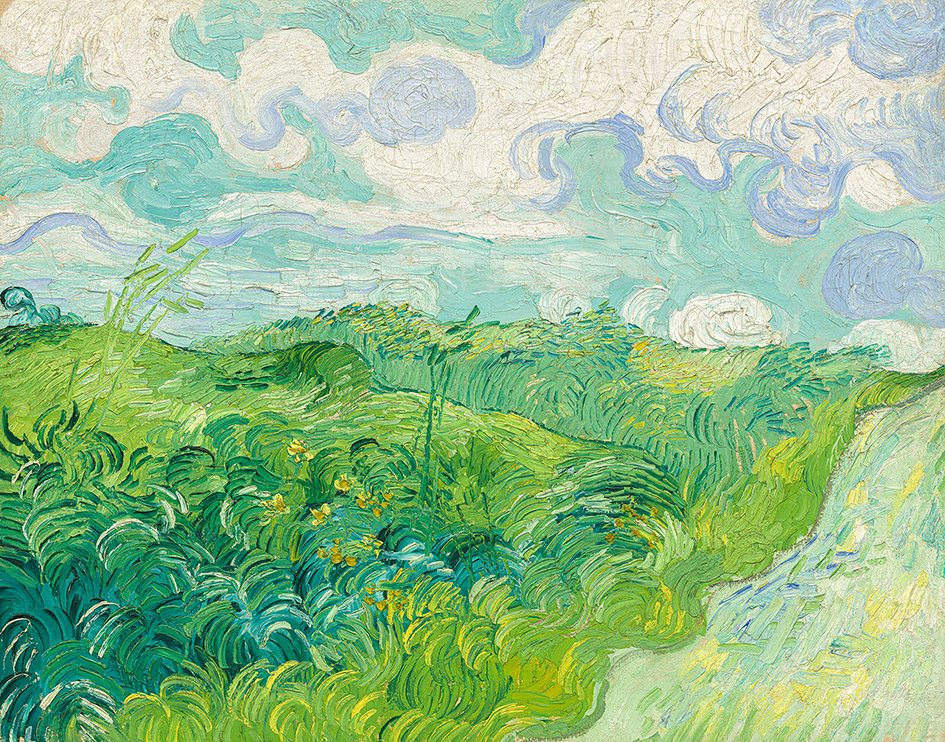
Green Fields
Vincent van Gogh (1853 - 1890), Auvers, 1890, oil on canvas, 72 cm x 91 cm.
Deeply inspired by the sun-drenched landscape and the picturesque character of the region and its inhabitants, van Gogh developed what would become his signature style, marked by lush impasto, energetic brushwork, and vibrant color. In May 1889, the emotionally troubled artist voluntarily admitted himself as a patient at the asylum of Saint-Paul-de-Mausole in nearby Saint-Rémy, where he remained for a year. In May 1890, he moved to Auvers-sur-Oise, where he stayed until he took his own life two months later.
Green Wheat Fields, Auvers was painted during these final months in Auvers. In this village just north of Paris, Van Gogh painted the Romanesque church, the town hall, and some of the picturesque thatched-roof houses. As he did in the countryside surrounding Arles and Saint-Rémy, he also painted more or less "pure" landscapes. This work is indeed singular in that there is no legible motif beyond the grassy field, road, and sky; no farmers or horse-driven carts; no rural structures. Instead, pure flora is whipped up by the wind. Two-thirds of the composition consists of the field in a rich range of greens and blues, punctuated by outbursts of yellow flowers. As in the paintings he completed in the countryside surrounding Arles and Saint- Rémy, here Van Gogh painted a “pure” landscape.
The artist wrote of his return to northern France as a kind of homecoming, a peaceful restoration of his mental state in which the vibrant, hot colors of the south were replaced by cool, gentle hues in green and blue. In Green Wheat Fields, Auvers van Gogh's energetic strokes describe the movement of grassy stalks in the breeze, their patterned undulations creating a woven integral form anchored at the right by a juncture of field, road, and sky. There, the turbulent vibrations are held in place, just barely. Overhead, clouds spin. Van Gogh's long calligraphic brushstrokes applied in thick impasto, creating a textured surface like that in his best-loved paintings. Through his dynamic touch and vivid, rich color, van Gogh expresses the intense freshness of the countryside.
The ninth oil painting by the artist to come to the collection, Green Wheat Fields, Auvers represents Van Gogh's wildly prolific Auvers period, along with the Girl in White. It hangs in the Gallery's West Building with several works from Arles, including La Mousmé and Farmhouse in Provence, as well as from his stay at Saint-Rémy, where he painted Roses and his blazing Self-Portrait. This powerful painting relates perhaps even more strongly to three of the Gallery's pen and ink drawings by Van Gogh, all from 1888 (The Harvest, Harvest—The Plain of La Crau, and Ploughman in the Fields near Arles), in the rhythmic marks used to represent nature's unifying energy.
Email: jancvanroekel@gmail.com