Postcards |
Intro van Gogh |
His Suicide |
van Gogh postcard
beautiful offset-printed
on 320 grs carton
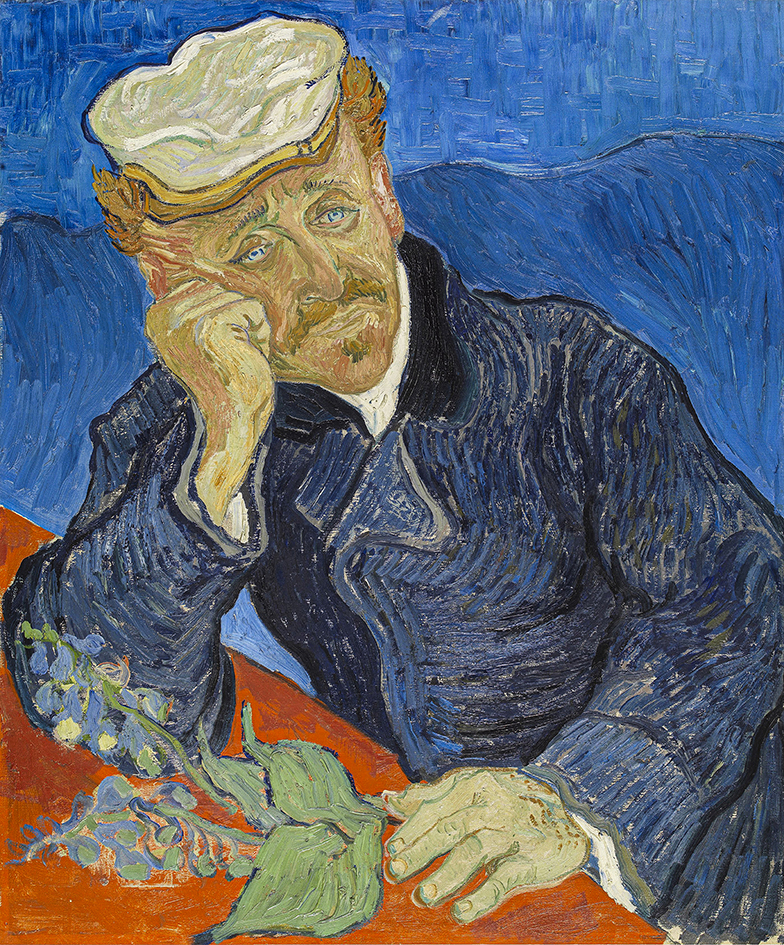
Doctor Paul Gachet
Vincent van Gogh (1853 - 1890), Auvers-sur-Oise, June1890, oil on canvas, 67 cm x 56 cm.
The Portrait of Doctor Gachet is one of the most revered paintings by the Dutch artist Vincent van Gogh. It depicts Dr. Paul Gachet, a selfmade homeopathic doctor and wannebe artist whom van Gogh met In Auvers. Gachet "took care of" van Gogh during the final months of his life. There are two authenticated versions of this portrait, both painted in June 1890 in Auvers-sur-Oise. Both show Gachet sitting at a table and leaning his head on his right arm, but they are easily differentiated in color and style. There is also an etching. The first version was acquired by the Städel in Frankfurt in 1911 and subsequently confiscated and sold by Hermann Göring. In May 1990, under the direction of Christie's auction house Chairman Stephen Lash, it was sold for $82.5 million ($198.6 million today) to Ryoei Saito, making it the world's most expensive painting at that time. It then disappeared from public view and the Städel was unable to locate it in 2019. The second version was owned by Gachet and was bequeathed to France by his heirs. Despite arguments over its authenticity, it now hangs in the Musée d'Orsay, in Paris.
In late 1888 van Gogh began to experience a mental breakdown, cutting off part of his ear. He stayed in hospital for a month, but was not fully healed and in April 1889 he checked himself into an asylum at Saint-Rémy-de-Provence, where he remained for a year. Released in 1890, van Gogh's brother Theo searched for a home for the artist. Upon the recommendation of Camille Pissarro, a former patient of the doctor who told Theo of Gachet's interests in working with artists, Theo sent Vincent to Gachet's second home in Auvers. Vincent van Gogh's first impression of Gachet was unfavorable. Writing to Theo he remarked: "I think that we must not count on Dr. Gachet at all. First of all, he is sicker than I am, I think, or shall we say just as much, so that's that. Now when one blind man leads another blind man, don't they both fall into the ditch?" In a letter dated two days later to their sister Wilhelmina, he relayed, "I have found a true friend in Dr. Gachet, something like another brother, so much do we resemble each other physically and also mentally." Van Gogh had a very prolific spell during his stay with Gachet, producing more than seventy paintings, including the portraits of Gachet. Van Gogh's thoughts returned several times to the painting by Eugène Delacroix of Torquato Tasso in the madhouse. After a visit with Paul Gauguin to Montpellier to see Alfred Bruyas's collection in the Musée Fabre, Van Gogh wrote to Theo, asking if he could find a copy of the lithograph after the painting. Three and a half months earlier, he had been thinking of the painting as an example of the sort of portraits he wanted to paint: "But it would be more in harmony with what Eugène Delacroix attempted and brought off in his Tasso in Prison, and many other pictures, representing a real man. Ah! portraiture, portraiture with the thought, the soul of the model in it, that is what I think must come." Van Gogh wrote to his sister in 1890 about the painting: I've done the portrait of M. Gachet with a melancholy expression, which might well seem like a grimace to those who see it... Sad but gentle, yet clear and intelligent, that is how many portraits ought to be done... There are modern heads that may be looked at for a long time, and that may perhaps be looked back on with longing a hundred years later.
The portraits of Dr. Gachet were completed just six weeks before Van Gogh shot himself and died from his wounds.
Email: jancvanroekel@gmail.com