Postcards |
Intro van Gogh |
His Suicide |
CafeNuit - van Gogh
beautiful offset-printed
top quality postcard
in set of 50 different cards
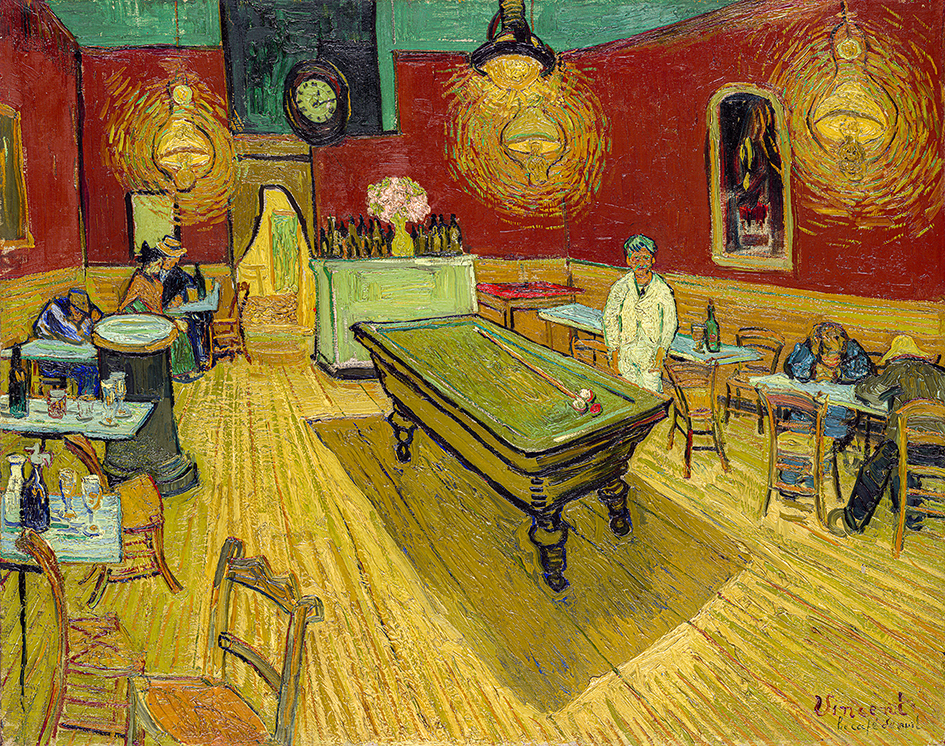
Cafe de la Nuit in Arles
Vincent van Gogh (1853 - 1890), Arles, 1888, oil on canvas, 72 cm x 92 cm.
During his nearly fifteen-month stay in Arles, Vincent van Gogh created this depiction of the Café de la Gare, an all-night establishment on the city’s Place Lamartine. With varying reds and greens, as well as saturated yellows applied in thick patches, the artist sought to convey—as he wrote to his brother Theo—“the terrible passions of humanity.” For van Gogh, these clashing colors not only evoked an aura of restlessness, but they also expressed “an idea that the café is a place where one can ruin oneself, go mad, or commit a crime.”
Vincent van Gogh painted Night Café (original French title: Le Café de nuit) in Arles in September 1888.
The painting was executed on standard French canvas. It depicts the interior of the café, with a doorway with a half-curtain in the central background leading, presumably, to more private rooms. Five customers are seated at tables along the walls. A waiter in a light coat stands facing the viewer.
The five customers depicted in the scene have been described as "three drunks and vagrants huddled in a large public room, either asleep or in a stupor . "
In August 1888, Vincent wrote to his brother in a letter:
"Today I'll probably start inside the café where I have a room, gaslit at night. It's what they call a café de nuit here (they're quite common here), which stays open all night. Night-dwellers can take refuge there when they don't have money to pay for lodging or are too drunk to be admitted."
This work has been considered one of van Gogh's masterpieces and one of his most famous.
Unlike typical Impressionist works, the painter does not project a neutral stance toward the world, nor an attitude of simply enjoying the beauty of nature or the moment. The painting exemplifies Van Gogh's use of what he called "suggestive color," or, as he would soon call it, "arbitrary color," in which the artist infused his works with his emotions, characteristic of what later became known as Expressionism.
Image of the painting "Night Café" by Vincent van Gogh
The perspective of the scene is one of its most powerful effects, according to several critics. Harris wrote that the perspective " throws the viewer into the room, into the private chambers with half-drawn curtains, and creates a sense of vertigo and distorted vision, familiar to nightmares ."
Email: jancvanroekel@gmail.com